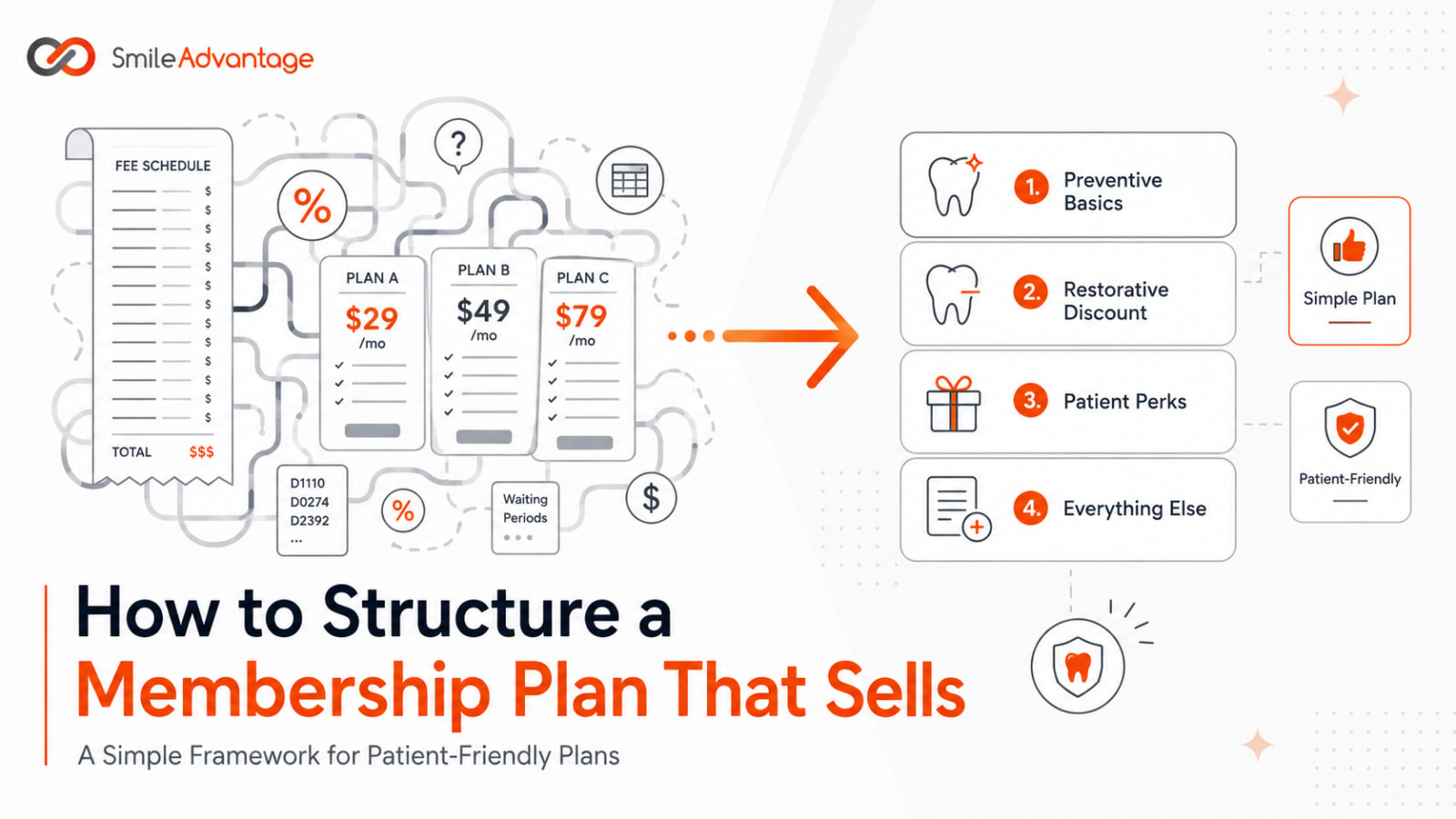
When a dental practice sets up a membership plan for the first time, the instinct is usually to account for everything. An adult plan, a family plan, a separate cosmetic tier, a perio option, and then a full fee schedule with a different discount mapped to every individual code. Before long it looks like a menu with dozens of line items.
That instinct is understandable. Years of working with insurance train a team to think in codes and percentages. But a membership plan has a different job. Its purpose is to be simple enough that a patient understands the value in about ten seconds and says yes right at the front desk. Every extra moving part makes that moment harder.
The good news: a strong membership plan really only needs four building blocks.
The Four-Part Framework
1. Include the preventive basics
Bundle the routine preventive care a healthy patient needs each year: typically two cleanings, exams, and necessary x-rays. This is the foundation of the plan and the part patients understand instantly. It answers the first question every uninsured patient has: “What do I actually get?“
2. Apply one clear restorative discount
Offer a single, consistent discount on restorative treatment such as fillings and crowns. One number is easy to quote and easy for patients to remember. Per-code pricing tables might feel more precise, but they create friction at the exact moment you need a quick yes. A patient who has to ask “what’s the discount on a crown versus a filling?” is a patient who might just decide to think about it.
3. Add a few genuine perks
Choose two or three extras that feel genuinely valuable and are easy for your team to deliver. A complimentary emergency exam, a whitening treatment, or a fluoride application are common choices. A short list of meaningful perks does more for enrollment than a long list of minor ones. When patients feel like they’re getting something special, the plan stops feeling transactional.
4. Use one modest discount on everything else
Cover all other treatment with a single small blanket discount. One percentage across everything not already in the plan keeps the offer complete and easy to quote on the spot. No spreadsheet required.
Why Simpler Plans Enroll More
A simple plan is easier on patients and easier on your team at the same time.
A faster yes at the front desk. When a patient can grasp the plan in a sentence, the decision feels easy. When it takes a minute to explain, doubt creeps in.
Smoother case acceptance. One restorative discount removes the per-code debate from treatment conversations entirely. The patient knows the number before you even start presenting a treatment plan.
Less day-to-day admin. Your team has no list to track which code earns which rate. New hires can learn the plan in five minutes.
Easy to maintain. When your fees change, you adjust one discount instead of rebuilding an entire schedule.
There is solid research behind this. Psychologist Barry Schwartz’s work on the paradox of choice showed that the more options people are given, the more likely they are to walk away without choosing at all. A meta-analysis of nearly 100 studies found this effect is strongest when people are under time pressure and cannot easily compare options, which is exactly the situation a patient faces at the front desk after their exam. A plan they can understand at a glance is far more likely to earn a yes than one that requires explanation.
The Instinct to Complicate It
Offices that have spent years working with insurance often feel like a simple plan is not detailed enough. If insurance covers things code by code, shouldn’t a membership plan match that level of specificity?
The answer is no, and the reason matters. Insurance is built to control costs for the payer. A membership plan is built to build loyalty for your practice. Those are fundamentally different goals, and they call for different structures. When you copy insurance logic into a membership plan, you end up with all the complexity patients are trying to escape.
A good rule of thumb: if your team needs to pull up a spreadsheet to answer a patient’s question about the plan, the plan is too complicated.
Putting Numbers to It
Once you have the structure, the remaining work is filling in your specific percentages and fees. Your office’s standard rates, your local market, and your patient mix will all shape what makes sense for your practice. The framework stays the same no matter which numbers you choose.
From there, you can decide whether to offer monthly billing, annual billing, or both. Monthly lowers the barrier for new patients. Annual rewards commitment and improves cash flow predictability. Most practices offer both and let patients choose. If you want to extend the same simple plan across a household, family bundling handles that without adding new tiers to manage.
The Takeaway
Include the basics. Discount restorative. Add a few perks. One simple discount on the rest.
If you find yourself mapping a different rate to every code on a fee schedule, pause and simplify. A plan built on these four parts is easier for patients to say yes to and easier for your team to run every day. The goal is not a plan that covers every possible scenario in the fine print. The goal is a plan patients are excited to join.